Growth Design
Sukoon: Bypassing Corporate Paranoia
Growth Designer / Product Strategist / Behavioral UX Designer

The Core Problem
High-Stigma, High-CAC. Standard B2C mental health platforms in Tier-2 India are financially doomed. The cultural stigma surrounding therapy drives Customer Acquisition Costs (CAC) so high that scaling through traditional ad spend is mathematically impossible.
The Output
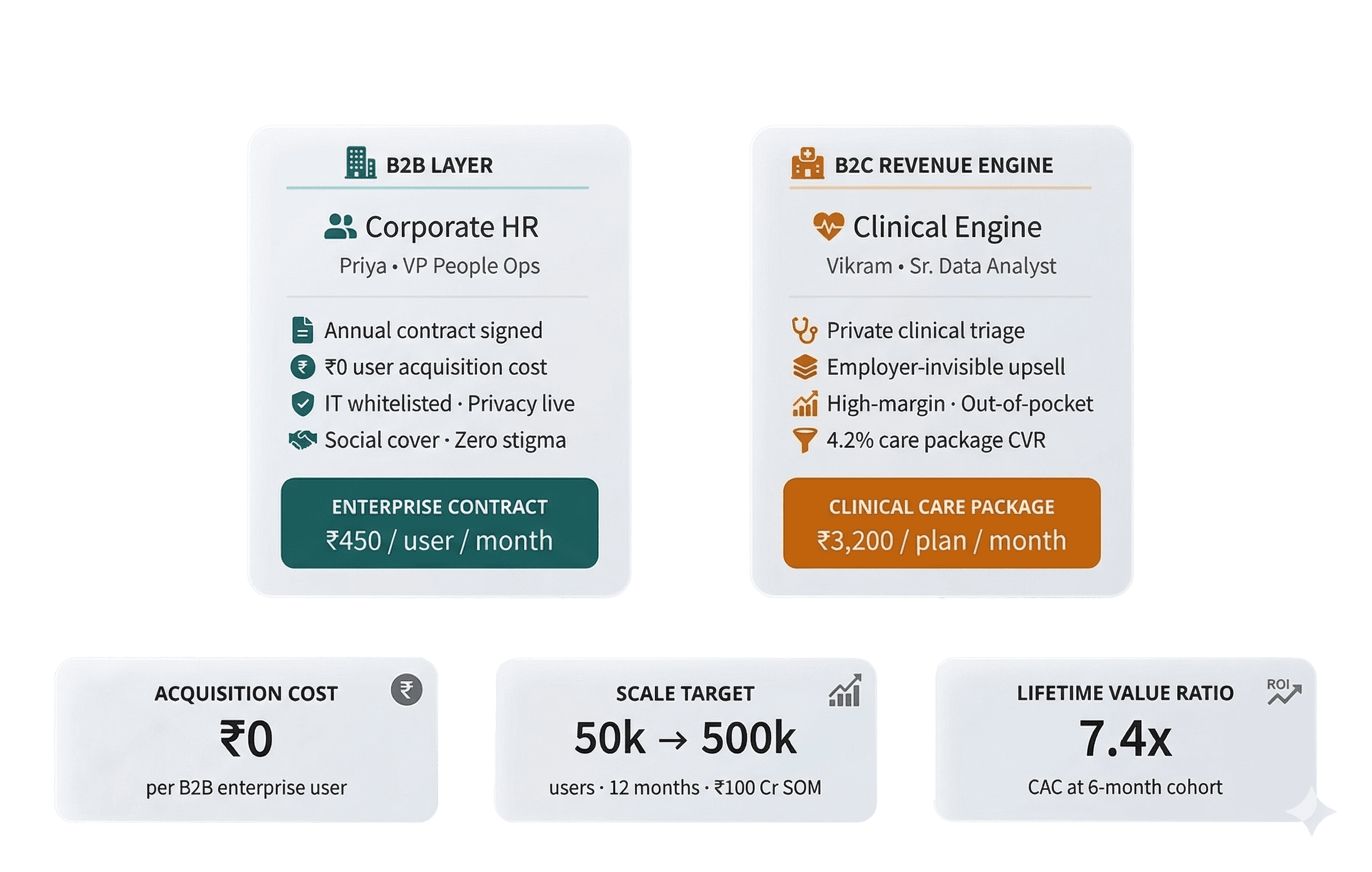
The Dual-Wedge Architecture. We engineered a B2B2C "Trojan Horse" system: a white-labeled corporate dashboard that bypasses stigma to acquire massive user pools at ₹0 CAC, seamlessly funneling them into a private, consumer-facing clinical app engineered for high-margin, out-of-pocket upgrades.
The Impact
Designed the growth architecture to scale the platform from 50,000 to 500,000 users. The growth wasn't from burning cash on ads. It was a self-funding loop of B2B contracts seeded the B2C pool, and doubling down on altruistic viral loops drove scale. We transformed the product from a low-margin empathy tool into a high-margin clinical revenue engine.

The Market Reality
76% of Indian professionals are burned out, but severe social stigma drives B2C acquisition costs to bankrupting levels. To bypass this CAC trap, we engineered a B2B2C Wedge strategy. By leveraging corporate wellness contracts, we acquire massive user pools at ₹0 CAC. Once safely inside, a private clinical triage acts as the psychological hook, seamlessly converting subsidized employees into high-margin, out-of-pocket clinical subscribers.
The Evidence
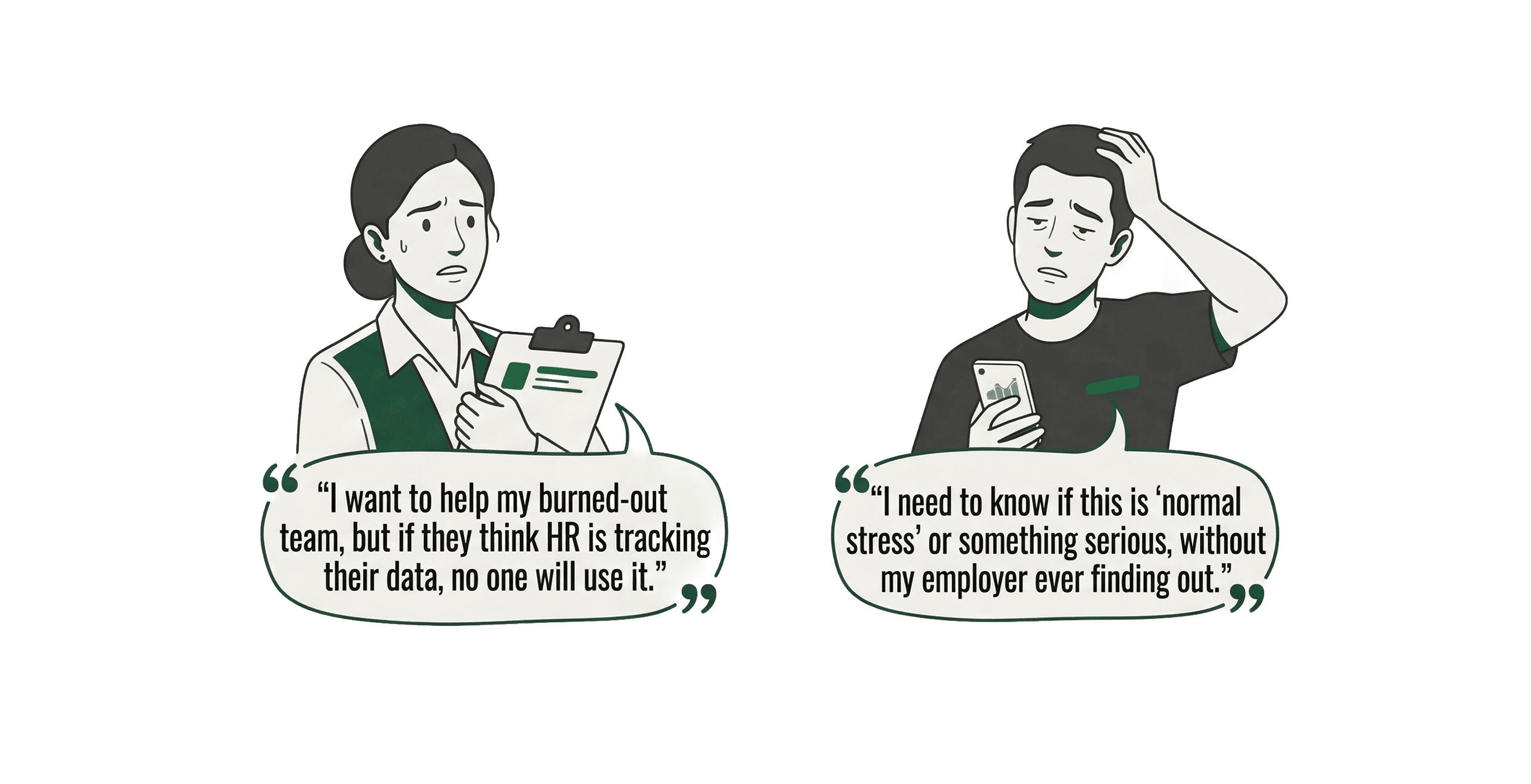
To find exactly where the market was bleeding, we ran a quantitative market analysis, and conducted 6-8 deep dive Switch Interviews across the full B2B2C triad: Corporate HR Directors, burned-out employees, and general professionals.
76% of Indian professionals report burnout, yet an 85% treatment gap remains because employees refuse to seek help due to intense social stigma.
Existing corporate wellness portals see an abysmal 1-2% utilization rate because of "Corporate Paranoia" where employees are terrified HR is tracking their data.
Replacing a single burned-out, mid-level employee costs a company 1.5x to 2x their annual salary.
Google Trends analysis reveals that acute stress, anxiety, and insomnia symptom searches peak drastically between 11 PM and 3 AM.
The North Star Metric (NSM)
Google Searcher → In-Person Triage Conversion Rate
This metric captures Sukoon's core value of "Prescriptive Confidence". It measures the exact moment a distressed user moves from 2 AM choice paralysis to receiving a clinically credible, personalized Mental Health Report. Improving this metric directly predicts revenue, once a user reaches this "Aha! Moment," the statistical probability of them converting to a high-margin B2C care package skyrockets.
The Go-To-Market Architecture
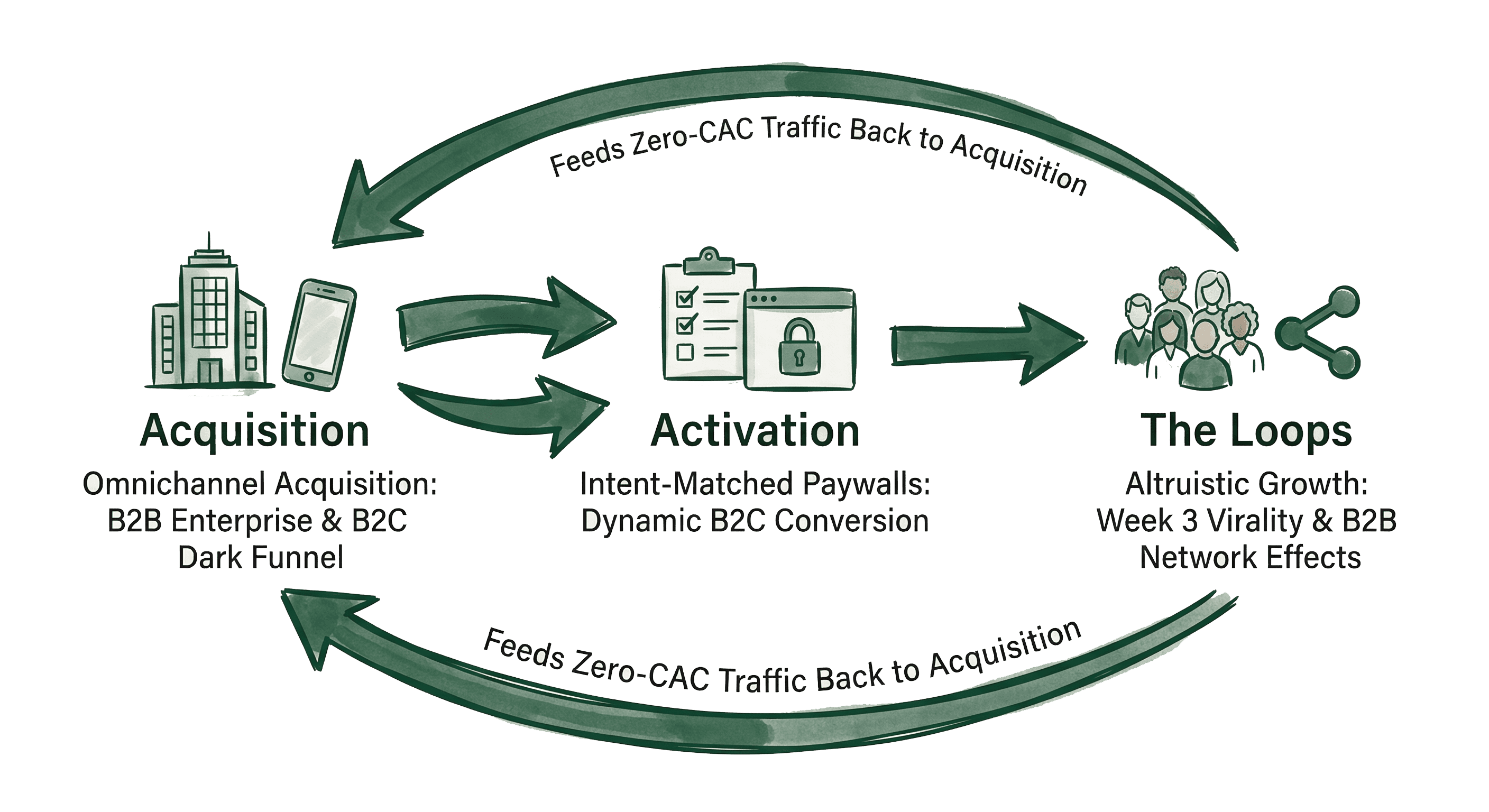
Based on the friction points uncovered in our research, we engineered a four-pillar distribution strategy to bypass stigma and slash CAC
B2B Concierge Acquisition: Executing the "25 Company Rule" outbound strategy, closing corporate HR contracts via frictionless concierge onboarding to unlock massive, subsidized employee pools.
B2C Omnichannel Capture: Funneling high-intent 2 AM "Dark Funnel" searchers into our digital Triage, while hijacking offline traffic via O2O spatial partnerships (deploying QR entry points in premium spas and salons).
Intent-Matched Conversion: We dynamically route incoming users (Triage leads, organic installs, referrals) into highly specific, source-matched B2C paywalls to maximize high-margin, out-of-pocket upgrades.
B2B Enterprise Network Effects: Leveraging successful corporate deployments to trigger high-trust word-of-mouth, turning active HR buyers into acquisition channels for new enterprise contracts.
Altruistic Virality: We trigger internal referral loops at the exact moment of clinical relief (Week 3), turning successful users into anonymous advocates who continuously feed warm traffic back into the funnel.
What Success Looks Like
With our GTM architecture locked, we mapped a surgical 4-Phase Beachhead strategy to hit our 500K users target in 12 months.
Beachhead "Bowling Alley" Strategy
Projected scaling model, plotting active user acquisition against compounded annual recurring revenue (ARR) over four strategic phases.
Growth-Driven Design
Here are 4 high-leverage UI interventions that mathematically scaled our B2B2C architecture.
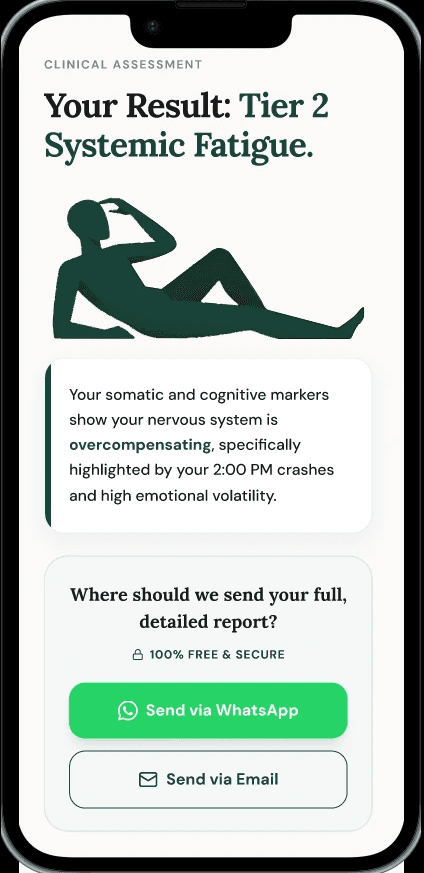
Triage Report
(B2C Acquisition)
Reduce B2C app-download drop-offs. Pushing a cold app download at 2 AM is fatal. We needed a new channel to capture leads before they hit the App Store wall.
Free Unlocked Value (FUV) and Priming. We give them a clinical PDF for free. This changes their internal question from "Do I want this app?" to "Where do I send my report?" A 2-step opt-in captures their WhatsApp/Email, giving us a zero-friction channel to nudge them later.
The Metric: Lead Capture Rate (WhatsApp/Email) & App Store CTR.
Decoy Paywall
(B2C Revenue)
Phase 2 B2C Revenue. We aren't selling a subscription; we are selling their first clinical therapy session. The UI must maximize cart perceived value at the moment of highest intent.
Decoy Pricing and Outcome Framing. We anchor the price with a single ₹1,000 session so the ₹3,200 clinical bundle looks like a massive discount. We close the deal using Risk Reversal (money-back guarantees) to kill purchase anxiety.
The Metric: Paywall Conversion Rate (> 8%) & Package Opt-in Rate (> 80%).
Delegating IT Friction (B2B Activation)
Slash B2B Time-to-Value (TTV). Enterprise deals die waiting for IT whitelisting. HR doesn't have technical skills, so we removed the burden from them entirely.
Frictionless Delegation and Poka-yoke (Mistake-proofing). HR simply inputs the IT lead’s email. The UI physically locks the "Upload Employees" step until IT confirms the domain is whitelisted, making it impossible for HR to cause a systemic email bounce.
The Metric: Time to Invite IT Lead (< 60s) & IT Invite Send Rate (100%).
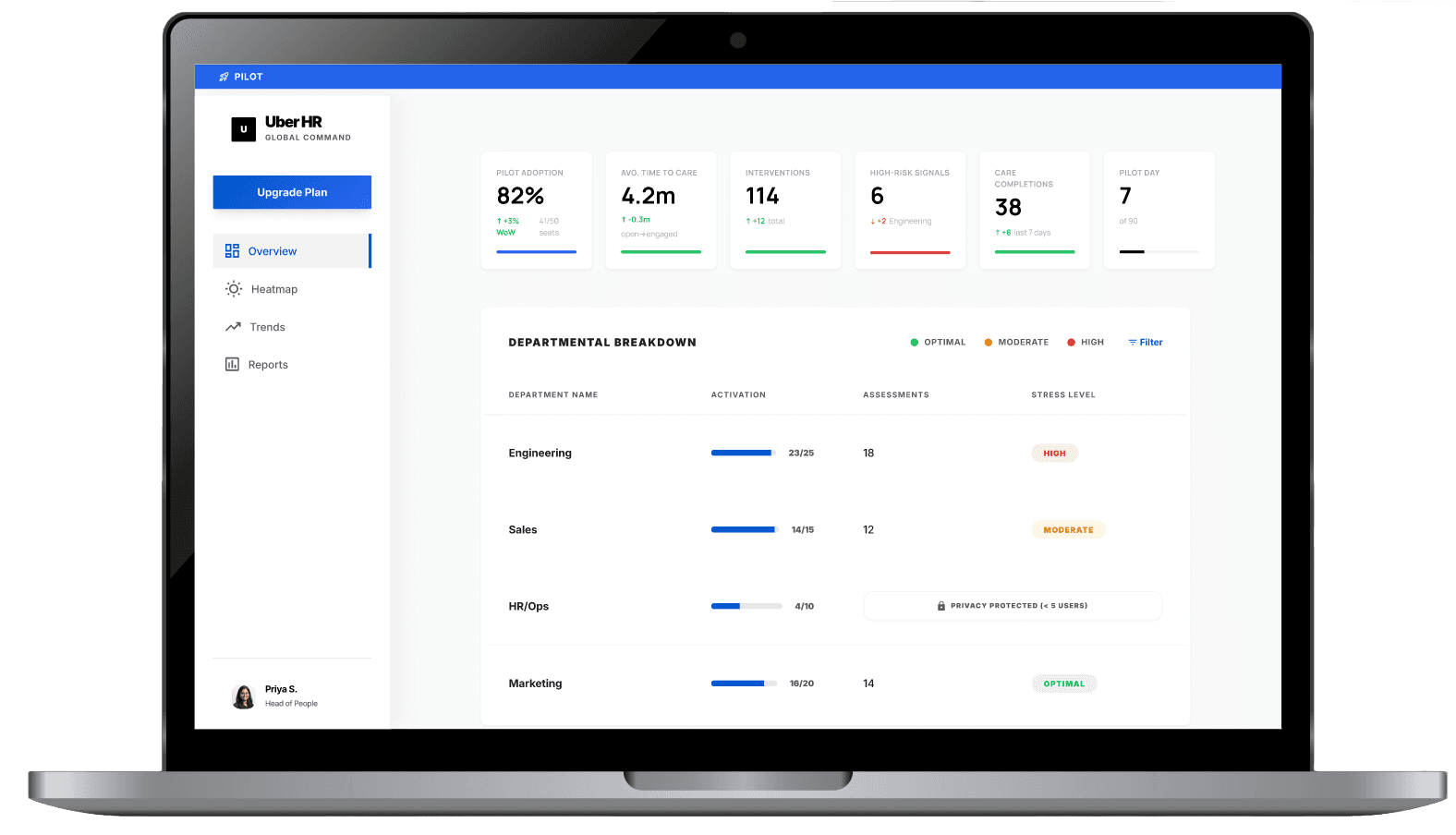
The "Rule of 5" Firewall (B2B Retention)
Secure B2B Retention for Phase 3 (Inorganic Growth). If employees think HR tracks their mental health, adoption dies. We had to visually prove "Corporate Paranoia" is wrong.
Privacy Wedge and Salience. If a department has < 5 active users, the UI visually locks that row with a padlock. We use Visual Chunking (Green/Yellow/Red) so HR instantly sees company "fires" and core ROI metrics without ever accessing raw, privacy-violating data.
The Metric: B2B Employee Utilization Rate & Dashboard Engagement.
Validation & Iteration
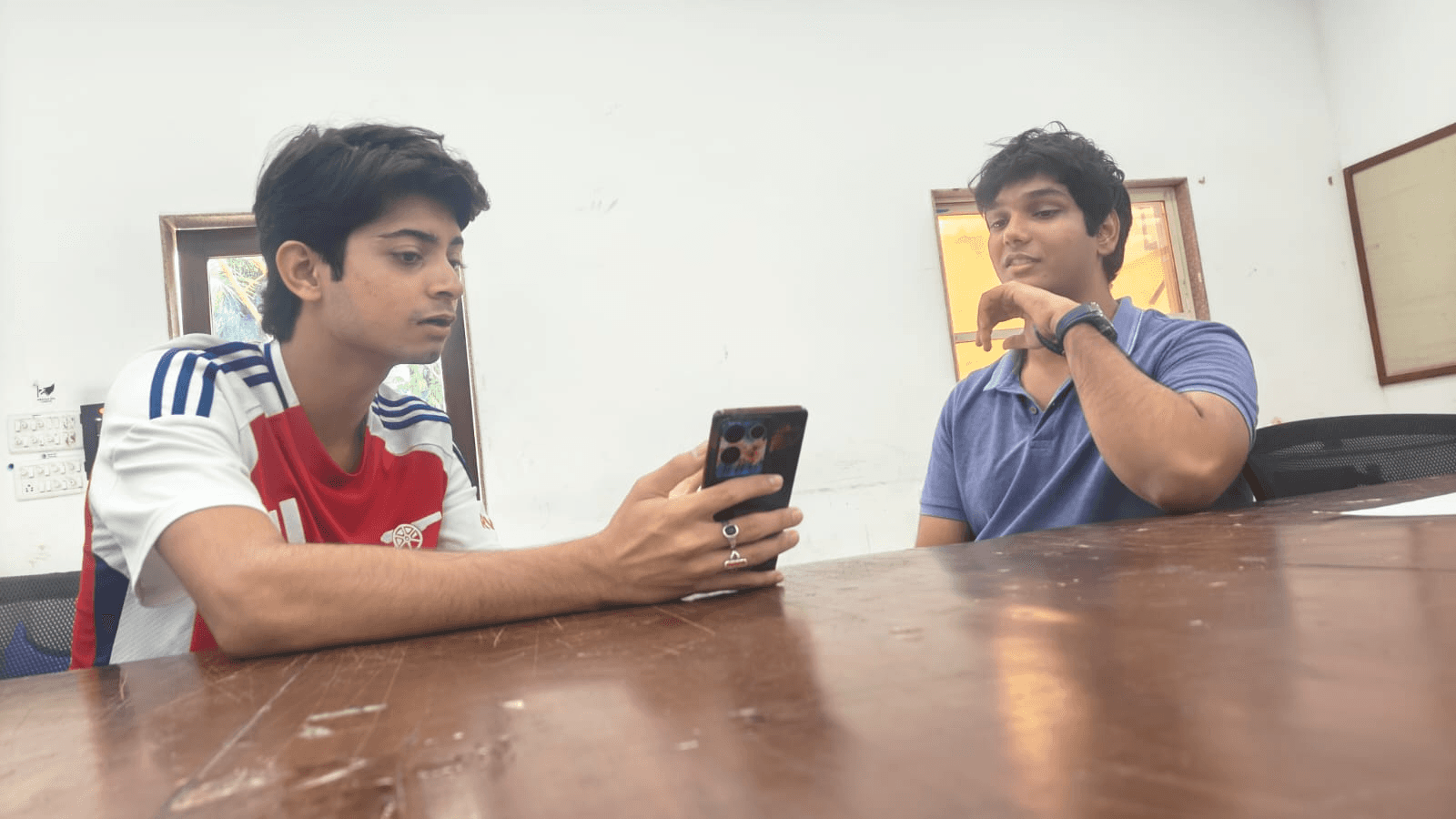
We executed rigorous Friction Logging and Conversion Rate Optimization (CRO). Using the Think Aloud protocol and live A/B testing, we stress-tested our core growth loops. We found one massive win, and one critical revenue leak.

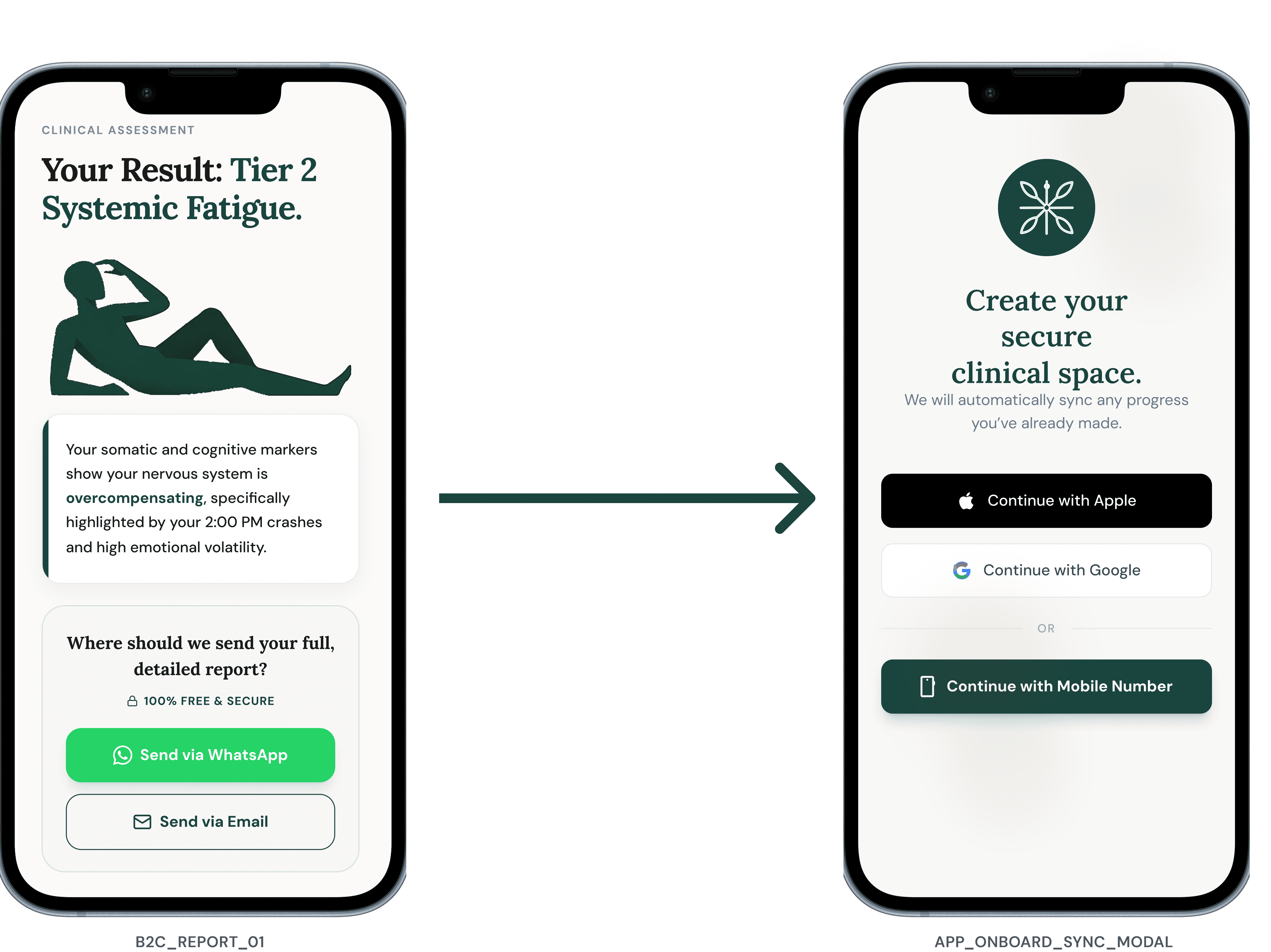
Insight 1: The Acquisition Win (Channel Continuity)
The Hypothesis Validated: We predicted that the exact channel a user selected to receive their free Triage PDF (WhatsApp vs. Email) would dictate their optimal login channel.
The Result: By mirroring their initial choice and auto-routing their login through that exact same channel, we eliminated decision fatigue and achieved near-zero friction in account creation.
Insight 2: The Referral Leak (Intent Mismatch)
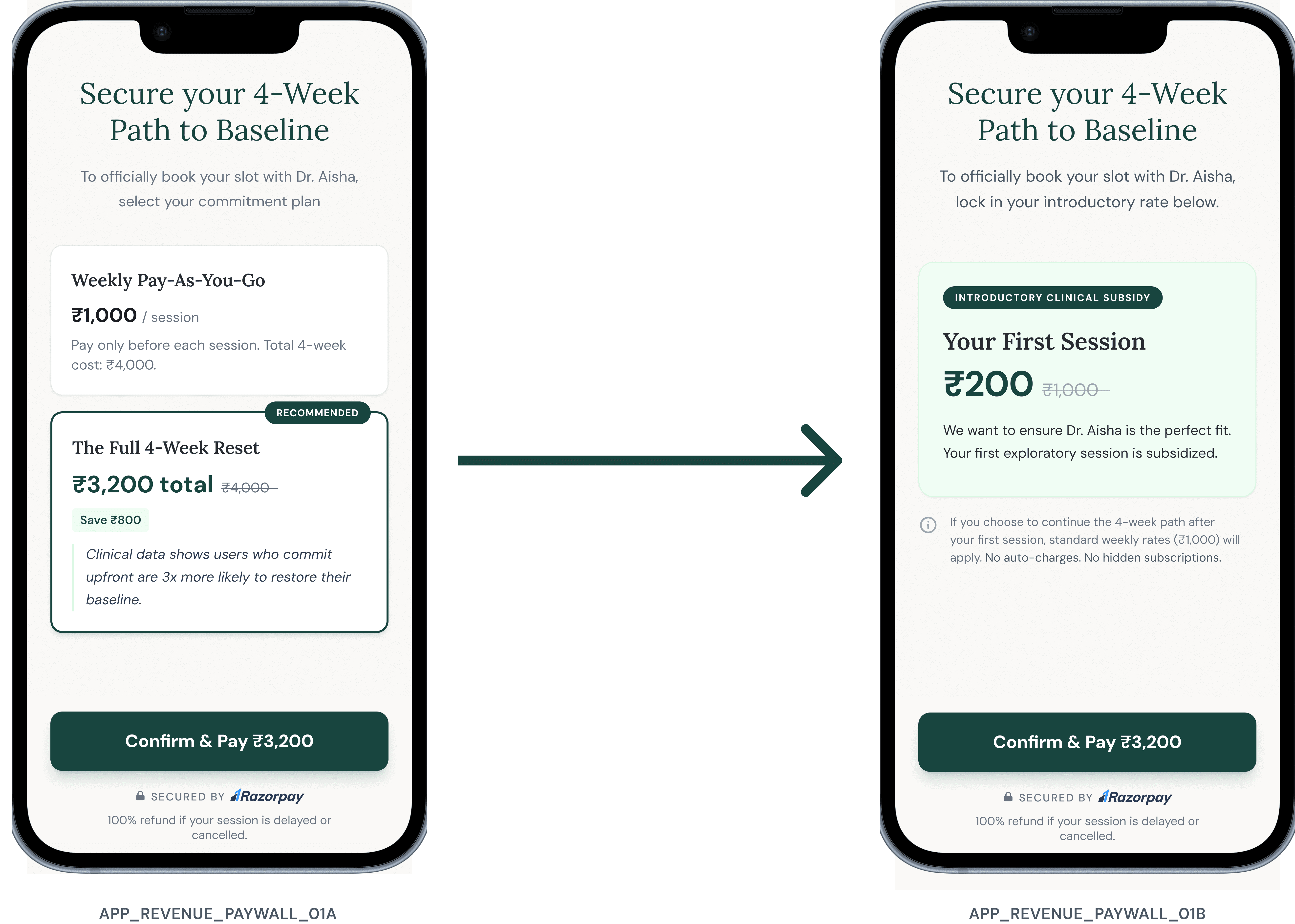
The Failure: Our standard ₹3,200 clinical bundle paywall was highly effective for our distressed 2 AM users. But in our viral referral loop, it failed completely. Referred users arrive via word-of-mouth; they just want to "try it out." Hitting a low-intent user with a 4-week financial commitment caused immediate bounce.
The Fix (The Trial Paywall): We architected a dedicated, separate paywall exclusively for referral traffic, We broke their financial inertia by anchoring the session at ₹1,000 and striking it down to ₹200. A low price point creates a high-conversion impulse action, built entirely around lowering the barrier to entry.
The Roadmap Forward
"Tier 1" Graduation (Maximizing LTV): Gracefully transitioning users from intensive clinical care to low-touch maintenance to build lifelong retention.
Scaling Proven Viral Loops: Aggressively expanding our most profitable zero-CAC channels: B2B enterprise rollouts and B2C altruistic referrals.
O2O (Offline-to-Online) Partnerships: Capturing high-intent physical traffic by placing discreet QR entry points in premium offline wellness spaces (spas/salons).
Key Learnings
Strategic Scaling: Aligned UX directly with business viability by mapping North Star Metrics, market wedges, and a phased Beachhead strategy.
Behavioral Psychology: Backed every UI decision with cognitive models (Anchoring, Altruism Effect, Loss Aversion) to predictably shape user behavior.
Conversion Architecture: Engineered high-intent funnels and paywalls using value stacking, dual-scarcity, and absolute risk-reversal.
Cross-Platform Acquisition: Designed psychological hooks to seamlessly transition anonymous, low-commitment web traffic into authenticated app users.
Data-Backed Iteration: Translated rigorous A/B and user testing into direct, conversion-boosting UI updates.